If you run a training company, school, academy or in-house learning programme, sooner or later you need a learning management system (LMS). The decision usually comes down to three routes: install an open-source platform such as Moodle, subscribe to a hosted SaaS LMS, or have one built for you. Each is the right answer for some organisations and a poor fit for others. Here is how to tell which is yours.
Quick takeaways
• Moodle is free software, but setup, hosting, theming and upkeep still cost money and time.
• SaaS LMS is the fastest start, but most charge per user, so costs climb as you grow.
• Custom LMS costs more upfront (typically RM25,000 to RM80,000+) but fits unusual programmes and has no per-learner fee.
• The best choice depends on your programme, not on which option is newest.
The short answer
Choose Moodle if you want maximum features, have technical help, and your teaching fits a standard course model. Choose a SaaS LMS if you want to launch quickly with minimal setup and your learner numbers are small or stable. Choose a custom LMS if your programme has rules, scoring, enrolment or reporting that off-the-shelf tools cannot handle, or if per-user fees will become expensive at scale.
Watch: Moodle in under two minutes
Video by Moodle on YouTube. It is a third-party explainer, so prices and tools shown may differ from Malaysian options; see our own figures above.
Side-by-side comparison
| Moodle | SaaS LMS | Custom LMS | |
|---|---|---|---|
| Software cost | Free (open source) | Monthly or yearly subscription | One-time build cost |
| Ongoing cost | Hosting, updates, support | Often per user per month | Hosting and maintenance |
| Speed to launch | Moderate | Fastest | Slowest (planned build) |
| Fit for unusual programmes | Possible with plugins | Limited to what the vendor supports | Built exactly to your rules |
| Control and ownership | High | Low (vendor controls it) | Full ownership |
| Needs technical help | Yes | Little | Handled by your developer |
Moodle: powerful, but not free to run
Moodle is widely used by universities and institutions because it is mature and flexible. The software has no licence fee, but a working Moodle site still needs hosting that can handle it, installation and configuration, a theme that matches your brand, plugins for anything beyond the basics, security updates, and someone who knows how to maintain it. If you have that in-house, Moodle is a strong option. If you do not, the “free” platform can become a slow, awkward project.
SaaS LMS: quick to start, costly to scale
Hosted platforms let you sign up and begin building courses almost immediately. That speed is the main advantage. The catch is the pricing model: many charge per active learner per month, and you are limited to what the vendor supports. If you grow from 100 learners to 1,000, your bill grows with you, and you cannot change how the platform behaves.
Custom LMS: built around your programme
A custom LMS is designed from your learner journey outward: how people enrol, what they see, how they are assessed, and what your team needs to report on. It makes sense when:
- Your scoring or assessment rules are unusual, such as competitions, panel judging or weighted rubrics.
- Your enrolment flow has steps standard platforms do not support.
- You need reporting that the usual tools cannot produce.
- Per-user pricing would become a major cost at scale.
- You want to own the platform and not rent it.
We built exactly this for a national competition where the scoring did not fit any standard model. See the Aggrovator LMS case study.
A three-year cost illustration
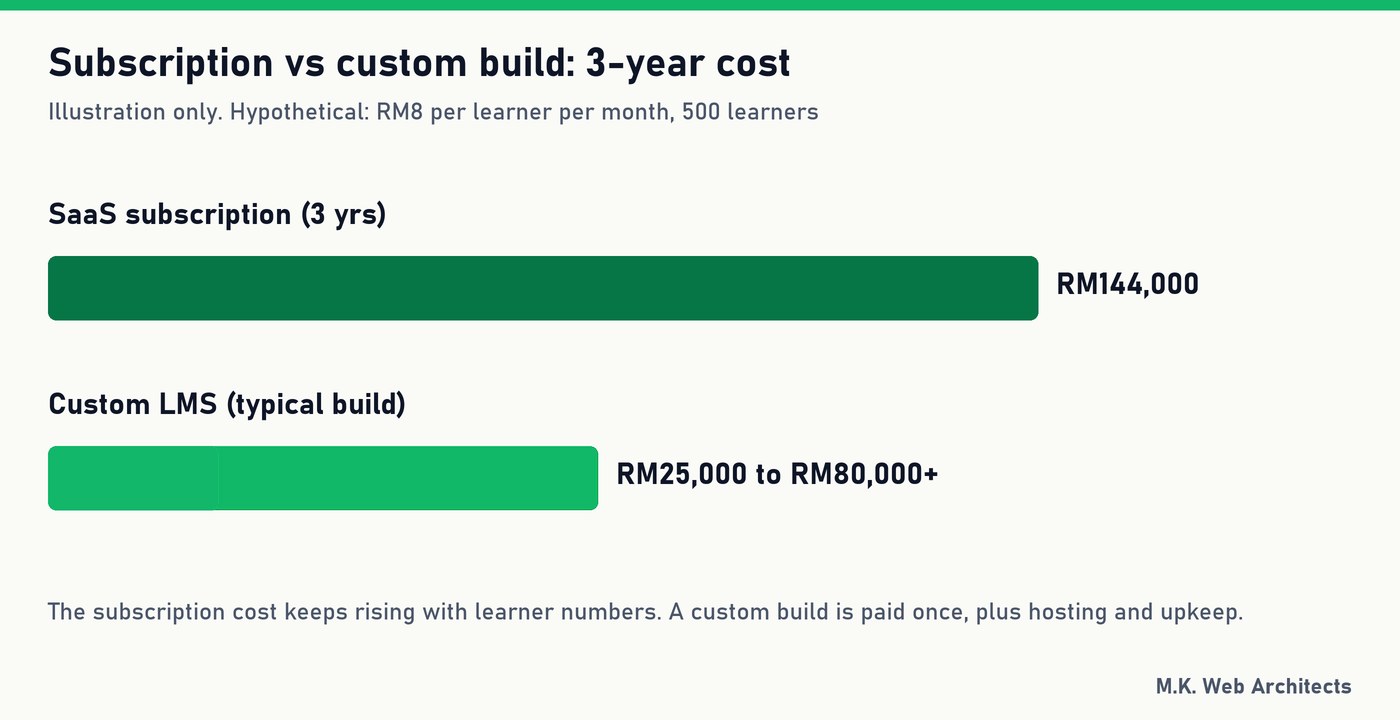
Costs depend on your own numbers, so here is a simple way to compare them. The figures below are hypothetical, for illustration only. Replace them with real quotes.
Suppose a SaaS LMS charges RM8 per learner per month and you have 500 learners. That is RM4,000 a month, RM48,000 a year, and RM144,000 over three years, and it rises if your learner count grows. A custom build, which typically runs RM25,000 to RM80,000+, is paid once, with hosting and maintenance on top. Past a certain learner count, the custom build costs less over time, and you own it.
The reverse also holds. With 50 learners and simple courses, a subscription is almost certainly cheaper than building anything. Run the numbers for your own situation before deciding.
Questions to ask before you choose
- How many learners do we have now, and how many in two years?
- Does our teaching fit a standard model of courses, lessons, quizzes and certificates?
- Do we have someone technical to run and update the system?
- Does anything about our assessment, enrolment or reporting need to work differently from the norm?
- What happens to our data and learners if a vendor changes pricing or closes?
If you decide to build, what training providers need to prepare before building an LMS covers the planning steps. For the wider build-or-buy question, read custom business system vs off-the-shelf software.
FAQ
Is Moodle really free?
The software is free, but you still pay for hosting, setup, design, plugins and ongoing maintenance, either in money or your own time.
Is a custom LMS more expensive than a subscription?
Upfront, yes. Custom builds typically run RM25,000 to RM80,000+. Over several years, a custom platform can cost less than a per-user subscription, especially as learner numbers grow.
When should I not build a custom LMS?
If you have a small number of learners and your courses fit a standard format, an off-the-shelf platform is usually the better value. A good developer will tell you this honestly.
Does an LMS in Malaysia have to follow PDPA?
Yes. An LMS stores personal data such as names, contact details and results, so it needs secure storage, access controls and clear data practices.
Next step
Describe your programme and we will tell you honestly whether an off-the-shelf platform or a custom build suits you, before you commit. See our LMS development service or talk to us.