Most Malaysian SMEs start the same way: a spreadsheet for orders, WhatsApp for customers, a shared folder for documents. It works, until it does not. Then the same data is typed in three places, someone overwrites a file, and a customer falls through the cracks. This guide covers seven signs you have outgrown that setup, and what to do before you spend money on custom software.
Quick takeaways
• If staff re-type the same data into several places, that is the clearest sign.
• Custom software is not always the answer. Try off-the-shelf tools first.
• Custom systems typically run RM25,000 to RM80,000+, scoped after a discovery conversation.
• Map your process on paper before you brief any developer.
The short answer
You likely need custom software when your core process is unusual, your current tools cannot be bent to fit it, and the time or errors caused by workarounds cost more than a proper system would. If a standard tool fits, use that. If you keep inventing workarounds, read on.
Watch: when to build vs buy custom software
Video by Baytech Consulting on YouTube. It is a third-party explainer, so prices and tools shown may differ from Malaysian options; see our own figures above.
7 signs you have outgrown spreadsheets
1. The same data is entered in more than one place
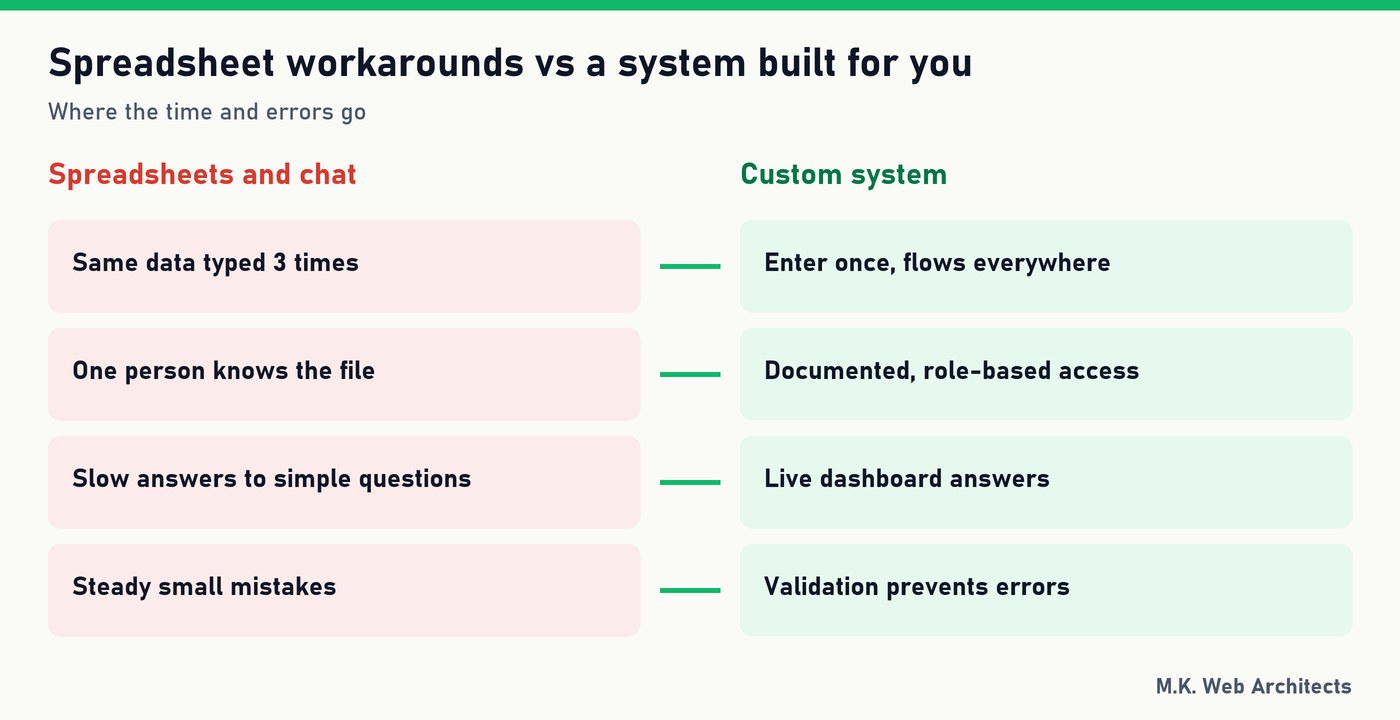
If someone types an order into a spreadsheet, then again into an invoice, then again into a delivery list, you are paying staff to copy information. Every copy is a chance for an error.
2. Only one person understands the system
When a single employee “knows how the spreadsheet works,” you have a hidden risk. If they leave or go on leave, work stalls.
3. You cannot get a quick answer to a simple question
“How many jobs are overdue?” or “Which customers have not paid?” should take seconds. If it takes an afternoon of filtering and cross-checking, your data is not working for you.
4. Mistakes keep happening
Double bookings, missed follow-ups, wrong quantities, overwritten files. Occasional errors happen anywhere, but a steady pattern means the tool is the problem, not the people.
5. Customers or staff need access, and you are emailing files
Sending spreadsheets back and forth, or screenshots over WhatsApp, does not scale. If clients, agents or branches need to see their own information, you need a portal or a system with logins and permissions.
6. Your process is different from everyone else’s
Standard software assumes a standard process. If your approvals, pricing rules, scoring or workflow are specific to your business, off-the-shelf tools force awkward workarounds. That is the situation custom software is for. We covered it in our custom business system vs off-the-shelf software guide.
7. Growth is making it worse
A method that worked for 20 customers a month breaks at 200. If you are planning to grow, your tools need to grow with you, or they will become the bottleneck.
Before you commission custom software
Custom is a real investment, so rule out the cheaper options first.
- Check off-the-shelf tools. Accounting, CRM, booking and inventory tools cover many needs well. If one fits, use it.
- Try to connect what you have. Sometimes integrating two existing tools solves the pain.
- Write down your process. List each step, who does it, what information moves, and where it goes wrong. This is the most valuable preparation you can do.
- Decide what success looks like. Fewer hours? Fewer errors? Faster response to customers? A clear goal keeps the project on track.
- Start with the painful part. You rarely need to build everything at once. A focused first version is cheaper and teaches you what you really need.
What custom software costs
Custom systems, web applications and portals are scoped individually because a simple internal tool and a multi-role platform are very different jobs. Typical engagements run RM25,000 to RM80,000+, with a fixed scope and quote after a discovery conversation. For the details, read custom web application development cost and process, and if you are unsure whether you need an app or a web-based system, see app, web app or portal.
FAQ
What is custom software?
Software built around how your business works, instead of a ready-made product you adapt yourself to. Examples include booking systems, customer portals, inventory tools and internal dashboards.
Is custom software worth it for a small business?
It can be, when manual work or errors cost you more each year than the system would, or when no standard tool fits your process. If a standard tool fits, it is usually the better value.
How long does it take to build custom software?
It depends on scope. A focused first version takes far less time than a full platform, and projects move faster when you have mapped your process in advance.
Do I own custom software after it is built?
You should. Agree in writing that you receive the source code, data and admin access at handover.
Next step
If you recognise three or more of these signs, it is worth a conversation. Describe your process and we will tell you honestly whether custom software or an existing tool fits. See our custom software development service or get in touch.